Fixatives give you two choices: workable fixative or non-workable fixatives. Well, neither one is really satisfying by title alone.
Let’s get the bad news over with first: most of them come in spray cans. Some have fluorocarbons, some not. I’m not a fan of spray cans, they take up a lot of space in a landfill. I’ve never seen a fixative in anything else except a spray can, although I’d be happy to hear about another application.
The spray can creates the ideal delivery system–tiny drops in a wide spray. The purpose of most fixatives is to keep charcoal, Conte crayon, pencil, and pastels from rubbing off.
The other purposes of a fixative is to protect your work from damaging UV rays and other environmental horrors. The best ones protect with a sealant that can be removed by conservators.
Here’s the important part: unless you use fixatives correctly, you will not be doing your artwork any favors. And most people don’t use them correctly. Here are some tips:
1. Make sure your artwork is finished. Including your signature. Any work you do after using a fixative is going to rub the sealant around the page, and that’s not so great for the paper or the medium.
 2. Several light spritzes are better than one blast. I see people do this over and over. They slap their expensive paper down, then apply fixative until the paper is soaked. This isn’t a brownie pan and it’s not non-stick spray you are wielding. The key to success is several light, sweeping sprays.
3. If your paper is wet, you’re doing it wrong. Keep the nozzle about a foot away from your artwork. Push the nozzle down and mist the paper in a gentle sweep. Pretend you are applying a wonderful perfume, rather than waterproofing your sneakers. Let it dry. Really. Dry till the back of your hand doesn’t feel cool when placed against the artwork. Then repeat. With a light touch, three coats are just right. With a heavy spray, one coat is too much.
4. Give the spray a chance to spread out. If you hold the nozzle too close to the paper the propellant will blow off the top layer of charcoal or pastel, and mottle your work with moisture. Holding the can a foot above the paper will give you the best results.
5. Choose the finish you want. Read the label. There are matte, transparent and gloss fixatives. Choose the one you want, not the one that’s there. Dickblick.com has a big variety worth checking out.
6. Clear the nozzle when you are done. The stuff you are spraying is a type of varnish. If you don’t clear the nozzle you will never use up the can because the nozzle will be hermetically sealed with fixative. To clear the nozzle, turn the can upside down, make sure the hole is facing away from you, and depress the nozzle. It will begin to spray, but after about 3 seconds, only the propellant will come out. Let the propellant hiss out for at least two seconds. Yes, this wastes some of the fixative. But if you don’t do it, you’ll waste a lot more as it gets stuck in the can.
7. If you are not done, use workable fixative. Workable means you can continue to work on the piece without smudging. Non-workable means you are done. If you continue to work on non-workable, you will be rolling varnish over the surface of your paper, picking up tiny rough pieces of chalk or charcoal. You are now scrubbing the surface of the paper, and bits of the paper are rolling around in this mess, too. When you go to put more charcoal down, it will be on a different surface and it will not look the same. You’ll have thicker and thinner layers of color, and the surface, now more absorbent, will mottle when you go back with more fixative.
A light touch, and letting the work dry completely before doing anything else is the best way to use fixative. Even a light touch can change the tonal value of your work. Before you “fix” it, let the fixative dry completely. You won’t have to work so hard.
Note: The blog has moved to my website, QuinnCreative.com
The comments for this post, written in 2008, have been closed. Your local art store is the best source for specific advice. They are current on the best products and application. I’m sorry, but I cannot answer specific questions about your artwork.
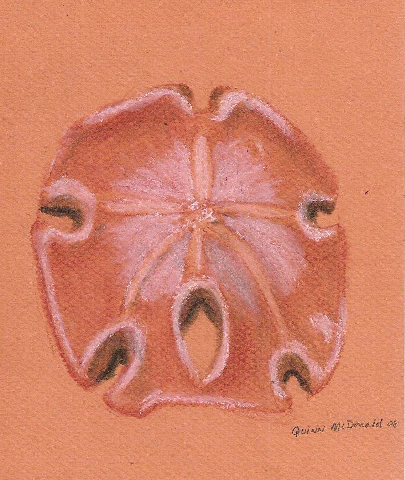
Image: Conte crayon on Canson 98-lb. Mi-Teintes paper. Quinn McDonald (c) 2008 Quinn McDonald is a certified creativity coach who has learned to wear shop aprons when working with glues and fixatives. See her work at QuinnCreative.com
 QuinnCreative
Pingback: How do I get a pastel ready for picture framing and how will it be framed? - Photo Frames and Picture Frames Online Store
Hi, great article. I’ve created 3d collage with acrylic paint on canvas and glossy photo paper butterflies stuck on. I’ve only attached their ‘bodies’ to the canvas, so that the ‘wings’ stick out. How can I preserve / fixate these butterflies. So that they don’t get damaged or fall off. Advice is greatly appreciated! Thank you!
The best way would have been to put fixative on the butterfly wings before attaching them. It’s going to difficult now, you would get overspray. If you used the right glue to attach them, they won’t fall off. If you want to preserve the piece, have a framer put it in a memory-type frame (they are really deep and can hold 3-D objects) and the butterflies won’t get damaged.
Hello,
I am planning to paint on a canvas (which has been primed with Texture White) using Charcoal and Oil colors. I plan to draw using charcoal and use a fixative and over it apply Oil colors for further details. Not complete canvas will be painted by oil and several places, initial charcoal work would be the only layer.
So I needed to ask, if I apply varnish later on my painting (after Oil dries), will the charcoal portion stay fine?
Is this an acceptable way of painting?
Frankly, I don’t know about mixing charcoal and oil. Your best course of action is to go to your local art store, staffed by artists, and ask there. They will know more than I do.
Hello, Thank you for your article.
I have a solid line graphite drawing (5H hardness) on Ampersand Claybord (Seems absorbent after a few tests with a workable fixative).
I need to seal this under-drawing so it can be seen in the final artwork.
I am applying an acrylic under-painting ON TOP of the Fixative.
Like I mentioned, I’ve ran a few tests with the workable fixative and the graphite still smears/dilutes with water.
I worry my under-painting with destroy my under-drawing because the workable fixative is not the right solution for sealing the graphite.
In case I’m unclear:
1. Ampersand Claybord
2. Graphite Drawing?
3. Some sort of Fixative?????????
4. Under-Painting (thinned Acrylic with water) -Liquitex Heavy Body
5. Airbrushed Acrylic (thinned with water) -Liquitex Heavy Body
6. Colored Pencil
I’ve shown you steps 5 and 6 just in case it matter to what you recommend.
Hopefully this is precise enough. Anything will help.
Sincerely,
RM
Using a workable fixative over a graphite drawing and then using anything that contains water makes it far more likely that the graphite, no matter how hard, will smear. If the under-drawing has to show, seal it with a permanent fixative. Acrylic should work just fine over a permanent fixative. If if doesn’t, use a Daniel Smith acrylic ground between between layers 3 and 4. That should work. Again, I’ve never tried this, I’m guessing what might work from your description.
Hey! i have made a sketch for a friend to gift him on his birthday with the pencil. I wanted to get the sketch framed ..so will the sketch after using Camel Artists Fixative Spray can be framed?
If you put glass in the frame, it should be fine. Fixative is not a preservative, it keeps the pencil from smudging. I’m not familiar with your brand, but the nature of fixatives is to keep pencil and charcoal from smearing.
Hi, I use soft pastels, with workable fixative on mixed media papaer. The questions that I have are this: Will workable fixative work as a final seal like the non-workable? I had one piece that I had finished that moisture got into a destroyed. Was that due to too much distance between the fixative and substrate or because of not enough layers(only one layer was used)?
Workable fixatives mean that you can go in and continue working on the piece. They are not a final seal. I don’t know how far you held the can from the paper when you applied it, so I can’t help you on that part of the question.
I’m starting some fountain pen sketching that I want to watercolour over. Fountain pen ink is either not waterproof or harmful to the pen. I was wondering if a workable fixative would do horrible things if painted over with watercolour having first sealed the fountain pen ink?
Here’s what I don’t know: what kind of ink you are using in you fountain pen, how you are going to seal the fountain pen ink, what your substrate is. Without knowing those, I can’t be accurate. Here’s my guess: If you are sealing over non-waterproof fountain pen ink with anything liquid, it will bleed. You may need several coats of gesso. Then a watercolor ground. I’d take the book to your local art store and get some help from someone who can see the paper and ask about the ink.
Help! Do you have any tricks for removing fixative spray (Blair No Odor Workable Matte Fixative) from paper? My son finished a great charcoal and pencil portrait of our dog on drawing paper (not sure what weight). He’s seen me use the fixative before, so he started spraying without me and ended up with some blobs and stains in the white spaces to the top and side of the portrait. Luckily it was only 1 coat.
Let the work dry completely, several days. You might be able to pick up the fixative with a kneaded eraser. Because I don’t know what kind of charcoal or what kind of paper, I’d suggest taking the drawing to a local art supply and asking them for advice.
Hi..sir i have done my work with charcoal very well upto my best.
I m an artist aged 14 studying in 9th standard and i want you to help me in my doubts.which spray would costs less and which one shuld i use as i m a beginner and i m going to display my art for in my first exhibition..plese suggest me
We probably live in very different countries, so I don’t know the brand name of a good fixative. Visit an art supply store and they will help you find just what you need.
I want to decoupage my drawings on wood, should I use fixative with the polyurethane or not…..
fixing a drawing is a separate step from gluing it. Fix first, glue last.
Hello,
I just read your article and I was wondering if I spray a fixative on a canvas will it be ok?
I did two of the same design and I prefer the pencil design than the acrylic one.
So will it change the design or be ruined because of the canvas?
Thank you
Be smart and take the canvas to your local art store. I don’t work on canvas, and I don’t know what kind of pencil or acrylic you used. All that makes a difference. An art store will be able to give you smart choices.
Hi Q— I sprayed an entire graphite pencil on smooth bristol work with a workable matte fixative. and let the piece dry. Can I erase to make an adjustment ? if I can make the adj, do I spray the entire piece again?
If you used a workable fixative, yes, you can rework it. When you are done, try spraying just that area lightly. Otherwise, the buildup won’t be even.
You can put fixative in a bottle and dip a venturi blower into it. Then you can re-fill the bottle endlessly
Clever solution, thanks!
Hello,
Thanks for such a great article. I am wondering should I use fixative only or along with varnish.
Nb: I draw on paper using wet mounting technique..
Thanks in advance
I don’t know how you draw using a wet mounting technique. For me, “drawing” is a dry technique. “Painting” is a wet technique. “Mounting” (at least in the studio) means gluing one thing on another. But to get to the other point–fixative keeps dry things, like charcoal or graphite, from smudging–tiny pieces moving around, leaving tinier pieces of themselves behind. Fixative stops that by using a very fine glue-like substance that dries quickly. Varnish is used (among other reasons) to protect artwork from UV damage and scratching or wearing. It’s made out of solvents. In my way of thinking (and I’m no expert, mind you), mixing fixatives and varnish is asking for trouble. If they are not immiscible, you will get a non-drying mess with bubbles. At best, you will get a sticky mess that will take forever to dry. You will be smarter to show your artwork to a local art store and ask what they suggest to seal it with.
Great site, been having some issues with fixative and stumbled across this blog while looking for answers, perhaps you can help. Ive recently started drawing seriously, I use graphit, carbon and charcoal pencils on smooth bristol board. Whenever I use fixative, especially in the dark areas [charcoal and carbon] the blacks turn grey, the details to mush and worst of all a dusty looking coat is left over the entire piece. Is this common? Am I using too much? Ive tried over a few drawings to use less and less but still finding the same problem, is there an answer or do I forgo fixative all together and draw only things I want framed?
thanks Eddie.
Buy a decent fixative. This is not the time to scrimp. Good fixatives (go to an art store and ask, not a big-box craft store) have a very fine nozzle. Don’t spray too close to your work. About a foot away, no closer. Small short bursts, you do not want to wet the Bristol board.
I just finished a charcol drawing for my moms bday but i need something quick but dont have any money, is there something ill find commonly in my house to keep it from smearing?
I’m a big believer in treating art like art, and not a kitchen experiment. I’ve had people tell me hair spray works, but unless it has a perfect, fine spray, you could cause a mess. Give the piece to your mom, and buy a fixative later.
hi! I am doing a canvas drawing of a guitar. the guitar is black so I’ve used charcoal for that, but I painted the background using acrylic. I want to spray the charcoal to make sure it doesn’t smudge as this is a present, but would it harm the acrylic if I was to spray the whole painting? I can’t spray just the guitar as it is too complex of a shape… thanks 🙂
There are many, many types of fixatives. Read the back and make sure they are acrylic friendly. And your best bet is to go to your local art store (not big-box craft outlet) and ask someone who uses acrylics–there are a lot of different types of plastic, which is what acrylics are. Asking people who use them will give you a good answer.
thanks for your help
Hello, great tutorial! I wonder if you could help me…I want to use charcoal and acrylic paint to draw/paint on a pebble. I don’t want to change the look of the stone. What fixative or lacquer would I need to use? Thank you. ela
Sorry, but I have no experience with drawing on pebbles. Hope you find an answer!
Hello, I’ve recently finished a black ink pen drawing and did a charcoal background… not sure if i should spray the fixative over it since i read ink won’t smear… but just to protect the overall drawing should i spray it anyway? will it ruin it somehow?
Depends on the ink. If the ink is waterproof AND the paper is a high quality paper, you can use a fixative for the charcoal. But make absolutely sure your ink won’t run first.
Hello, I recently purchased a large notebook agenda and the design on the front, back and corners are starting to rub off. The cover is made of a hard cardboard material and the design is white with gold foil dots on it. I am thinking about using a fixative to spray over the outside to protect the design. Would the fixative work? What kind would be best? Would I apply it the same way I would if it were a drawing?
Thanks so much,
-d
Answers to questions like yours are hard to do long distance and without knowing anything about the book construction, whether the foil was hot stamped or just press-stamped, what kind of cardboard that is, or what the white color is–paint? Acrylic? Paper? Vinyl? If the corners are rubbing off, it’s from wear–you are rubbing the corners on your purse, hands, other books. A spray fixative will not last long. It’s thin, and will wear off along with the corners themselves. You could try painting the corners with three coats of a painting sealer. It may soak into and ruin the cardboard, it could lift off the foil stamp. But if you are ready to experiment, go ahead. I’d be careful with matte or gloss medium, as it may take a week to dry fully.
My daughter did some art at school that consists of partially and completely melted crayons on cardstock. Very cute but starting to crack and separate from the paper. Is there a fixative that could help keep it intact?
It depends on the paper, but largely melted crayon is wax or oil, and most likely the oil dried and can no longer adhere to the cardstock. It might help to stabilize the cardstock by putting in on something stiffer–like board, but the melted wax will need to be glued into place. A layer of acrylic gloss medium will hold it, but it will also show around the crayon.
Hi, I just fixed my art work, AND THEN read this tutorial. So I think I got too close, and my finger was partially over the nozzle when I was spraying it. Now there is a few distinct drops on my paper.. Will these dry and if not is there any way to fix it so that they aren’t noticable. They landed on the white part of my paper where I didn’t have any marks.
Let it dry completely. It should be fine, unless your fingers had something on them that stains paper–grease, hand cream, charcoal. Don’t do anything until it has a complete chance to dry. If it’s left a mark, you may have to trim the artwork.
Hi I am doing a conte drawing on a wood surface and would like to know if I could use a high gloss spray after using a gloss fixative? Or what would be the best way to go about achieving a strong high gloss
Cheers
I’d start by trying the two different sprays on the back, to test the wood for acceptance. I don’t know what kind of wood you are using or if you used gesso or other ground, or even what color conté crayon you used. It should work, but I’d try it on an inconspicuous surface first. It’s an experiment in the first stage. If you just want a super shiny surface, consider having it framed with plain glass.
What kind of fixative would be best to use on live plants? I want to create art work with dandelions but am not sure if hair spray or an art fixative would work best. Does anyone have any experience with this?
It depends on what you want to do with dandelions–press them, preserve them in 3d? Unless you encase them, they will lose their white fluff. Hair spray is not meant for anything but hair. It will stain your substrate and remain sticky for life. Live plants need to be dried out completely before using any fixative.
Hello!
I am an amateur artist and just working with a Staedtler pigment liner (0.2 mm) on sketch pad paper to stipple a drawing like this: http://www.miguelendara.com/art/hero/
I just noticed some smudging on my hand and was wondering how I could prevent the ink from rubbing off. If you have any tips on how I could preserve my drawing I would really appreciate it.
Thank you, and I love your blog!
The easiest thing i can think of is fingerless gloves–thin ones, in cotton. Another choice it so use a mahl stick, they were designed to do just that. Hope one of those works for you.
Thanks! Do you have any tips on what kind of fixative I should be using for pen ink?
I’m not sure why you would need a fixative for pen and ink–it won’t smudge. You might want to use a UV protectant or a scratch resistant coating. Lascaux makes a scratch-resistant one. Dick Blick (art supplies) sells a big variety, you can read about them on the website.
I have a multi-media book I’m putting together – it was painted with craft quality acrylics on mixed media (110lb) paper. The paint isn’t making the pages buckle/warp too much – which is good, but I am running into issues where some of the pages are sticking to each other – I’m wondering other then wax paper what can i use to seal it? I will be shipping it overseas so I can’t control the temperature it will be kept at – i don’t want to use anything that will make it more tacky then it already is….thoughts/ideas?
Craft quality acrylics take a long time to dry. The more humid it is, the longer it takes.
You can’t seal it, because paint needs to be dry to seal, and once it’s dry, there won’t be a problem with sticking. Meanwhile–leave the book open,covers weighted to allow the pages to splay. At the grocery store, buy cooking parchment paper, and cut pieces slightly larger that each page to separate the pages. Don’t send the book till the pages are dry, even with parchment separators, because a tightly shut, wet book will develop mold. You will know it is dry when your fingers, when pressed into the paint, come easily away without any sticking.
If the book is going to be displayed open, then sealing becomes a good idea. Acrylic paint attracts dust and the dust becomes one with the surface over time. A sealant keeps the colors bright and can be cleaned without damaging the paint. I like Golden’s products, so I’d use Golden Polymer Varnish with UVLS (UltraViolet Light Stabilizers). Again, I haven’t seen your artwork, or know what kind of paint you used. Always test on a piece of paper that won’t make you cry if you ruin it.
SpectraFix workable fixative
is available in either a spray can or a concentrate that you mix with a clear alcohol, such as vodka. No odor, no fumes. Avaiable through Dick Blick & probably through other suppliers.
Thanks for the recommendation. I’ve never used it, so it’s good to hear from someone who has.
Hello, I just bought some gloss fixative and i’m not sure if i made the wrong choice, because there wasn’t any matte fixatives at my store.
I use sketching paper(drawing paper is too expensive for me), it’s by Art Alternatives and I often have a range of drawings that go from color pencil to graphite(maybe charcoal if i get into it). My gloss fixative is Grumbacher, but when it says to check the website for instructions, the file isn’t found.
So… pretty much i’m asking if i made the wrong decision in picking the type of fixative :[
If you wanted matte fixative and you bought gloss, you already have something you don’t want. Sketching paper is very lightweight, and you’ll have to spray it about 18 inches away in short spurts with drying in between so as not to soak the paper. And it will be gloss, which you didn’t want. If I were you, I’d scribble on a sheet of your paper using the materials you did on the artwork. Then test that piece of paper with your fixative to see the results.
I acutally odn’t mind the gloss now, but how can I tell if the fixative is on or not. I find myself spraying on a coat, letting it dry for maybe like 5 minutes, then attempting to smudge a corner to see if it was applied. At times I find that there are certain areas that aren’t coated. Should i just give it another quick coat and test it out?
Also I want to know, does temperature outside affect the drying process? Because I didnt have to wait 15-30 minutes for it to dry, I don’t know if it was because it was almost 100 degrees outside(I did it in the shade)
And… is it bad that i’m spraying my fixative work in the backyard, where the wind sometimes blows the fixative towards my parent’s plants?…. Is the food going to be toxic?
Thank you very much for answering ><"
Let’s see if I can answer some of these–if the spray nozzle is clogged, you will get an uneven spray. That’s why you spray it several times, to get a good, even cover. Temperature does have a lot to do with drying time, but so does humidity. High humidity makes for slow drying, even in high heat. Never spray if it’s windy. The fixative will drift and it’s not good for plants, patio sets, or pets. I don’t know what plants it drifted to, so I can’t tell you if the food is going to be toxic. The better way to spray is in a big box that surrounds the piece. (Opening on the side). Place the piece inside, and spray.
I have a charcoal drawing where I used a gloss fixative. Can I lightly spray over with a matte to tone down the gloss?
You unfortunately didn’t give me enough information to give you an informed answer. What kind of paper? What kind of charcoal–stick or pencil? Vine or pressed? What kind of gloss fixative? Spray? Brand name? How did you apply it? Brush? Compressor? Spraycan? How much did you use? One coat? Six? What kind of fixative do you want to spray on top? My suggestion would be to take it to an art store (NOT a Michael’s or Hobby Lobby, but an art store like Utrect or Daniel Smith), bring the drawing with you and ask an expert. Someone needs to look at it to make the call. Sorry I can’t help.
Just stumbled across your site and was wondering if you have any advice for me. My kids are making artworks like these
http://www.chiccheapnursery.com/2011/do-it-yourself/diy-how-to-make-a-crayon-monogram/
for Christmas gifts for their teachers this year, however I’ve just realised in our hot Australian climate, the crayons may actually melt and ruin the piece.
Do you think a fixative would ‘seal’ whole crayons and prevent them from melting, or can you think of anything else which may serve that purpose? Wishful thinking perhaps? Cheers.
Love that crayon monogram! What a clever idea. I don’t think a fixative will keep a crayon from melting. You’d have to encase it in something stronger than a fixative, and that would create a lot more problems. I live in a hot climate, too, so my first suggestion is to see if the crayon actually melts. Take several crayons and leave them out on the counter to see what happens. Crayons are pretty sturdy, particularly if you buy the better brands. They contain less wax. Because you are making it indoors and it will hang indoors, I’m guessing that there won’t be a problem other than the transport from your house to the school. If that’s true, then put the artwork in a box, put a towel over it and place ice bags on the towel while transporting. Do not put ice bags directly on the artwork.
If the crayons do begin to melt on the counter, you can substitute inexpensive colored pencils, which would achieve the same effect and can be cut with a saw or Dremel tool. Let us know what happens.
I have been doing graphite drawings for commissions for a couple of years, and I am concerned now about the safety of those drawings. In the classes I have taken over the years, we used a workable fixatives for charcoal and chalk pastels, but never as a sealant. Classmates often sprayed their work with hairspray, but I never felt that was safe. But now, after reading this tutorial, I am concerned that I have been cheating these people out of a good piece that will last. Is fixative completely necessary, should I rush out and get some?
Hair spray is a bad idea. It’s not meant to be a fixative or a sealant. It’s not archival. If your graphite drawings are framed, you don’t need to worry about a fixative. But if your stack your work, and pick it up by the edge and drag it under another sheet, you are pulling graphite off in little chunks. A fixative helps.
Hi i learned a lot so far but i have a final question!
I work with conte on white charcoal paper. The problem i have is that the conte powders from my work mess up my white paper when i try to blow them off the paper or just shake the paper to remove them! Does the workable fixative help to have a clean painting too? meaning could i easily blow off the waste powder after applying the workable fixative without it spreading color and messing my paper up?
Please let me know!
thank you
I wouldn’t spray a fixative before working with charcoal or conte. A fixative is meant to hold particles on the board. I’d use a pick-up instead–the bags filled with eraser dust. They work well.
I just sprayed some workable fixative on my watercolour picture, I’ve let it dry for the recommended hour, but I can still smell the spray when I go close to it. Is it not set yet? Being able to smell it makes me a bit unsettled, as I don’t want to inhale fumes or chemicals. Is it safe once it’s dry?
Another post suggested some do it yourself fixatives, which I havent tried.. one was gum arabic and a touch of glycerin, and water and to spary with an airbrush. I have all of these and will likely try it in a trail piece. I have fix that is years old and have never clogged the sprayer. it just keeps on working, but darkens the drawing a lot, so I am looking for other methods for my last touches. I always fix with a matte fix between layers.
Fixatives are tricky, at best. I’ve never tried gum arabic as a fixative, although I could see where it would work. Be careful of matte medium as a fixative. It can get cloudy if applied unevenly.
i’ve been working on a colored pencil piece and i’ve smudged it. the background i want to keep white. is there any way to remove little smudges without having to paint the background white? also is there any way to make a do-it-yourself workable fixative? i like to work in my bedroom and can’t spray that horrible smell?
If the paper is quality paper, an electric eraser will take care of smudges. You might want to try a kneaded eraser, then a white one, first. Work lightly.
You also might find it useful to put a piece of paper towel under you hand while you are drawing. It reduces smudges transferred from the oil on your hand to the paper. I know of no do-it-yourself fixative. You can do some research for ones that don’t smell or have different chemicals, or go outside to spray.
Can you help me? I used a Workable Fixative on my art and smeared it badly afterwards. I thought I was using a Matte Fixative. Now, I’ve bought a Matte fixative and started spraying my work and the charcoal falls off if I touch it! My work has already faded and smeared from when I sprayed the Workable Fixative on it. What am I doing wrong?
What kind of art are you doing? (Charcoal only or charcoal on with something else like conte crayon?)
On what kind of surface? (Bristol board, paper, gesso’d board?)
What kind of fixative–spray or paint it on? What brand?
Matte Fixative–what does it say on the can (Brand name and some words like “permanent” or “workable.”)
My guess–and it’s just that–is that you sprayed the first fixative on too heavily or too close to the paper. That would cause soaking and smearing. The matte fixative is different from the workable and isn’t blending well, because the charcoal already absorbed the other fixative. But I’ll know more if you send me the information.
How long does it typically take for yours to dry?
Depends on the humidity in your area. East Coast, leave at least one minute between very light spray coats; West Coast about 30 seconds. Paint-on fixatives take much longer. Use a piece of paper to touch a corner of the painted surface and see if the paper leaves a mark. —Q
Thanks for the advice. I have seen the bad results of thinking I had to soak the paper.
Hi Quinn, I ran across your fixative “tutorial” while hunting the right fixative for a peculiar piece of work. On a well gessoed canvas I began drawing with Conte crayon what was intended to become a mixed media contraption with acrylic paint, crayon and whatever else. At some point I decided to leave it as one big 3×4 ft. drawing. Normally, I spray varnish on an acrylic painting after one month. Should I use the same matte varnish for this drawing and is it okay to do so immediatly after the drawing is done? Thank you for any light you can shine this way, I’m kinda new at this. Jim
—-Jim, my gut tells me that a fixative is going to be better for conte crayon than varnish. While conte crayons are considered hard pastels, they feel as if they have a wax binder in them. I’d think spray varnish would diminish some of their delicacy. I”d use a workable fixative till you are sure you are done, then use a permanent fixative. I’ll check with my art teacher tomorrow night, she works more in conte than I do. -Q
I definitely need this fixative stuff; anything I try to draw or paint or whatever looks pretty brokative.
–Ah, Pete, you crack me up! Oh, wait, now I need fixative! -Q